
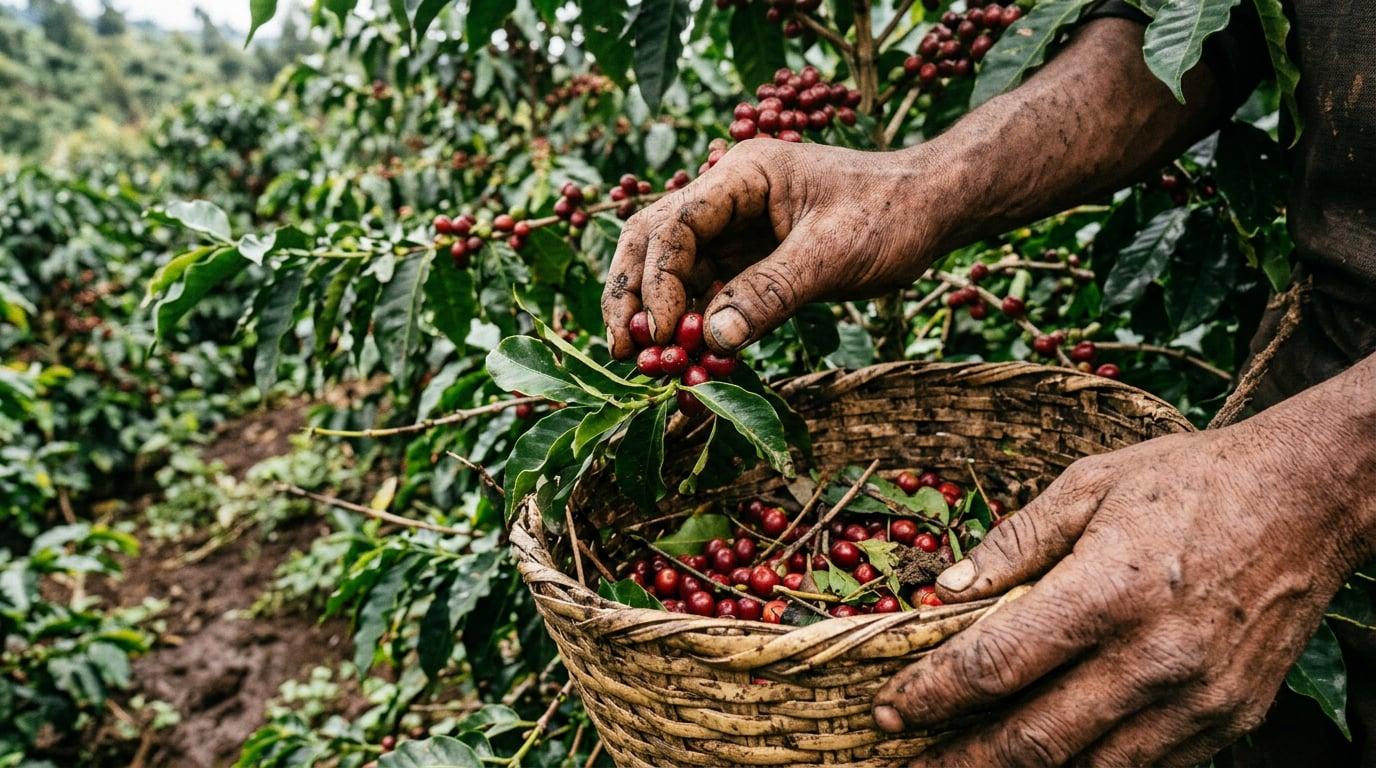
The crossing between Vilar Formoso and Fuentes de Oñoro concentrated the highest volume of legal and informal traffic between the two countries from 1882 onwards. CTB-003 documents that real historical pass — Napoleonic battle, emigrants' train, railway smuggling — and connects it with Contrabando's INTENSE coffee profile.
Lote CTB-003
Interior · máxima densidad
- Estado
- Activo
- Rareza
- Élite narrativa
CTB-003 cierra el trío CTB fundacional: para quien quiere sticker de paso mayor y vocabulario que suene a archivo, no a cupping de feria.
Ficha de archivo — zonas documentadas
- Pack
- Pack Contrabando
- Perfil de café
- INTENSO
- Zonas citadas
- Vilar Formoso (PT) · Fuentes de Oñoro (ES) · Beira Interior
Fuentes de Oñoro: The Peninsula's Main Crossing
The crossing between Vilar Formoso and Fuentes de Oñoro has been the most important border pass between Portugal and Spain for two centuries. The reason is geographical: it is the point where the Salamanca plain — the Roman campus lusitanus — comes closest to the Portuguese plateau without major natural obstacles. That flatness was decisive in wartime. On 3 and 5 May 1811, the Battle of Fuentes de Oñoro was fought here, in which Wellington's troops halted Marshal Masséna's advance towards Ciudad Rodrigo. It was one of the last major offensive operations of Napoleon's forces in the Peninsula, and the name of the village was recorded in British Army registers as a symbol of allied resistance.
In 1882, the Beira Alta Line connected Lisbon to the Spanish border at Vilar Formoso, linking with the Salamanca-Medina del Campo line. The railway transformed this crossing into the main point of entry and exit for goods and passengers between the two countries. The station of Vilar Formoso, decorated with azulejo panels illustrating Portuguese history and the railway opening towards Europe, was for decades the first contact many Portuguese emigrants had with their country on returning from France or Germany. The line was also informally known as the comboio dos emigrantes: the emigrants' train.
Railway infrastructure made this pass the most active commercial corridor on the Luso-Spanish border. With that activity came railway smuggling: passengers on the Lisbon-Madrid train hid coffee, tobacco and penicillin in clothing bundles, false-bottomed suitcases and under the bench seats of second class. The Guarda Fiscal and Spanish Customs agents knew the train was an informal distribution channel, but exhaustively checking each convoy would have halted the service for hours.
Beira Interior: Granite, Wool and Coffee in Transit
The Portuguese Beira Interior is a region of transition. To the west, the Serra da Estrela — with Torre at 1,993 metres, the highest point of continental Portugal — closes the horizon with permanent winter snow. To the east, the plateau slopes gently towards Vilar Formoso and the Spanish frontier. Between the two extremes, a territory of granite, walled medieval villages (Monsanto, Belmonte, Trancoso, Almeida) and an economy historically based on sheep farming, rye cultivation and wool production for the Guarda and Covilhã markets.
This region was for centuries a zone of transit, not destination. The medieval pilgrimage roads, the wool routes towards Atlantic ports and, later, the railway configured a territory that always looked outward: towards Lisbon, towards Castile, towards emigration. Coffee did not grow here — Portugal was never a producer — but it was the indispensable social lubricant in a region where taverns and weekly markets were the only spaces of public sociability.
Coffee reached the Beira Interior from Lisbon and Porto, sometimes by rail and sometimes along the muleteers' roads crossing the hills towards Guarda and Pinhel. In the rationing period (1943–1948 in Portugal, longer in Spain under estraperlo quotas), coffee was a luxury that the poorest adulterated with chicory, roasted barley or dried figs. Those who could afford it pure did so through informal networks connecting Guarda or Covilhã warehouses with smugglers operating on the Vilar Formoso frontier.
Trust Networks and Origin Traceability
The Colombian specialty coffee roasted in Barcelona shares with the old Iberian corridor networks a fundamental principle: quality is only maintained if every link in the chain is known and responsible. In the clandestine distribution networks of the twentieth century, a supplier who delivered adulterated goods was expelled with no possibility of return. Reputation was the only asset that could not be recovered if lost.
In today's specialty coffee trade that principle is formalised with precise tools: the green buyer selects farms by name, documented variety and verifiable processing. The roaster certifies the roast curve and honestly declares sensory notes. The end consumer receives a product with verifiable data on the label, not empty promises. Transparency is not marketing: it is the minimum condition for the 'specialty' designation to mean something rather than becoming another commodity with a pretty name.
The Contrabando Pack, associated with CTB-003, concentrates that proposition: INTENSE profile with Colombian traceability, Barcelona roasting, no intermediaries diluting the origin story. The Vilar Formoso — Fuentes de Oñoro corridor — the most surveilled and most active Iberian railway smuggling route for decades — serves as a historical reference for something that has not changed in essence: networks that move quality products always depend on the trust of those who participate in them.
The Specialty Coffee Ritual at Home
Specialty coffee is more accessible at home than it appears with three basic tools: a burr grinder (not blade), a kitchen scale and a clean extraction method. With a plastic V60, filter paper rinsed with hot water and 250 ml of water between 91 and 94 °C, anyone can reproduce at home the profile the roaster designed. Professional barista equipment is not necessary: attention and consistency are.
For the INTENSE profile of CTB-003, the recommended ratio is 1:15 (sixteen grams of coffee for 240 grams of water), medium-fine grind, spiral pour over three and a half minutes. The first extraction may surprise: the body is more marked than a soft Colombian, and the acidity is less evident but does not disappear. If excessive bitterness appears, opening the grind two clicks and dropping the temperature one degree are the two most effective adjustments.
The ritual is not in the expensive equipment but in conscious repetition: the same dose, the same method, small adjustments until finding the point that fits your taste and time of day. Specialty coffee has a defined sensory profile that you can learn to identify and reproduce. That is what turns the cup into a ritual rather than a mechanical act.
How to Recognise a Quality Intense Coffee
A well-roasted intense-profile coffee is recognised by three sensory markers: dense and persistent body in the mouth, restrained low-to-medium acidity (present as a counterweight to the body, not absent), and dark-toned notes without aggressive astringency: dark cocoa, toasted nuts, mild spices like pepper or cinnamon, sometimes wood.
What it should not have: ashy or metallic aftertaste — a sign of excessive roasting — bitterness dominating the first third of the cup — indicating under-extraction or too-high water temperature — or humidity or mould in the smell of freshly ground beans. If buying intense coffee for the first time after a supermarket blend, the most noticeable difference will not be the bitterness (which decreases) but the depth: more layers of flavour that reveal themselves as the cup cools.
To preserve the profile, store in an opaque, airtight container away from direct light, heat and moisture. Do not store in the refrigerator unless the container is vacuum-sealed. A quality intense coffee has an optimal consumption window between ten and thirty-five days from roasting.

¿Cómo llegaba el café a esta ruta?
El paso Vilar Formoso — Fuentes de Oñoro fue el corredor ferroviario más importante entre Portugal y España desde que la Línea de la Beira Alta se inauguró en 1882. El tren Lisboa-Madrid tardaba unas doce horas, y en cada viaje llevaba correo, mercancías y viajeros que muchas veces también llevaban pequeños lotes de café, tabaco o textiles que no declaraban en aduana.
El café brasileño, que llegaba en grandes cantidades a Lisboa a precios inferiores a los españoles por el diferencial arancelario del franquismo, encontraba en el tren su principal vía de distribución informal hacia la meseta castellana, Extremadura y Madrid. Los agentes de la Guarda Fiscal portuguesa y del Resguardo Aduanero español registraban maletas y bultos en la estación de Vilar Formoso, pero con doscientos o trescientos pasajeros por convoy era imposible una revisión exhaustiva.
Hoy el café de Contrabando no necesita el ferrocarril clandestino: viaja en transporte autorizado desde Barcelona, con etiqueta de trazabilidad y precio declarado. El corredor Vilar Formoso — Fuentes de Oñoro sigue siendo el paso más transitado entre los dos países, ahora como autovía A-25. Lo que CTB-003 recupera del archivo histórico es el principio de distribución confiable: en redes donde la reputación del producto importa, la calidad se mantiene.
Preguntas frecuentes
- ¿Qué importancia histórica tiene el paso Fuentes de Oñoro — Vilar Formoso?
- Es el cruce fronterizo más importante entre Portugal y España, relevante en dos momentos históricos: la Batalla de Fuentes de Oñoro (mayo de 1811, Wellington frente a Masséna) y la apertura del ferrocarril Lisboa-Madrid por la Línea de la Beira Alta (1882). El paso fue también el principal corredor del contrabando ferroviario durante el franquismo y el Estado Novo, por donde circulaba café brasileño de contrabando desde Lisboa hacia la meseta española.
- ¿Qué es el café de especialidad y en qué se diferencia del convencional?
- El café de especialidad supera 80 puntos en la escala SCA (Specialty Coffee Association), con trazabilidad documentada desde la finca hasta la taza, sin defectos primarios en el verde y con perfil sensorial definido. El café convencional mezcla orígenes sin documentar, se tuesta oscuro para uniformizar defectos y tiene un perfil plano. La diferencia en taza es perceptible: acidez limpia sin amargor residual, notas sensoriales específicas y un perfil que se desarrolla a medida que la taza se enfría.
- ¿Cómo llegaba el café de contrabando en el tren Lisboa-Madrid?
- Los pasajeros escondían pequeños lotes de café brasileño en maletas con doble fondo, fardos de ropa o bultos de mano que los agentes de aduanas no podían revisar exhaustivamente. El café era significativamente más barato en Lisboa que en España durante el racionamiento franquista, lo que creaba un incentivo económico claro. Las estaciones de control de Vilar Formoso y Fuentes de Oñoro eran el punto más intenso de inspección, pero con trenes de más de doscientos pasajeros era imposible una revisión completa.
- ¿Cómo reconocer un café intenso de calidad frente a uno industrial?
- Un café intenso de calidad tiene cuerpo denso y persistente, acidez contenida pero presente, y notas oscuras sin astringencia agresiva (cacao, frutos secos, madera). Un café industrial oscuro tiene retrogusto ceniciento, amargor que domina toda la taza y ausencia de notas sensoriales específicas. La diferencia más llamativa al probarlo por primera vez es la profundidad: más capas de sabor que se revelan a medida que la taza se enfría.
- ¿Qué incluye el Pack Contrabando y el Plan Specialty?
- El Pack Contrabando es la compra puntual asociada a CTB-003 con el café de perfil INTENSO. El Plan Specialty incluye tres bolsas por ciclo para quienes quieren explorar varios perfiles con reposición automática. Precio, contenido y disponibilidad de ambos en las fichas del catálogo.
Documento audiovisual
Fuentes y memoria
Lecturas y piezas externas que documentan el contexto histórico de esta ruta.